



Economic Snapshot: Strong returns despite inflation and conflict
The 2025–26 financial year delivered solid returns for many investors, but the path was far from smooth.
Global economic growth remained resilient despite ongoing inflation concerns and renewed geopolitical tensions, particularly in the Middle East.
One of the strongest drivers of markets continued to be artificial intelligence (AI), with significant investment flowing into technology infrastructure, semiconductor production and supporting industries. These trends helped global share markets outperform many other asset classes.
As the year progressed, investors became more aware that inflation risks had not fully disappeared. Higher oil prices and continued government spending raised concerns that central banks might not be able to cut interest rates as quickly as previously expected. Bond yields remained elevated as investors demanded higher returns to compensate for inflation and uncertainty.
Commodities generally benefited from strong demand and supply disruptions, while currency markets favoured the US dollar due to the continued strength of the US economy. Australia faced additional challenges from higher interest rates, softer consumer confidence and policy changes affecting housing and investment markets.
Global Developed Equities
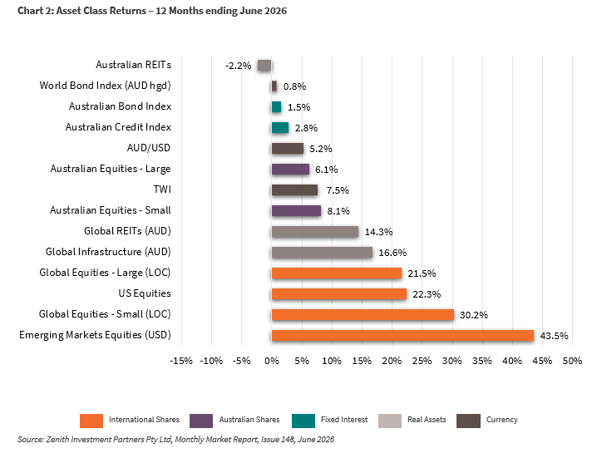
Global share markets enjoyed an exceptionally strong finish to the financial year. Investors largely looked past geopolitical tensions and focused instead on strong economic activity, healthy company earnings and ongoing investment linked to AI. Global shares returned around 14% over the June quarter and more than 22% for the financial year in hedged terms, making it one of the strongest years since the post-pandemic recovery.
AI remained the dominant investment theme, but leadership broadened beyond the large US technology companies that drove early gains. Investors increasingly favoured semiconductor manufacturers, data-centre operators, power infrastructure providers and businesses supporting AI deployment. This benefited markets such as Taiwan, South Korea and Japan, where many of these industries are concentrated.
In the United States, strong corporate earnings continued to support share prices despite concerns about valuations. Importantly, gains began spreading beyond a handful of mega-cap technology companies, with smaller companies and non-technology sectors improving.
Japan also delivered strong returns, supported by corporate reforms, favourable monetary conditions and improving global trade. Overall, investor confidence remained supported by resilient economic growth, easing oil prices and expectations that central banks may avoid further significant tightening.
Australian Equities
Australian shares produced positive returns but lagged global markets. The local market returned just over 6% for the financial year, compared with substantially stronger gains across many overseas markets. A major reason for this underperformance was Australia's relatively limited exposure to the technology and AI sectors that drove global returns.
Resource companies provided a bright spot as commodity prices strengthened, helping the materials sector perform strongly. However, this was largely offset by slower growth in banks, weaker healthcare performance and ongoing pressures on households from higher interest rates. Businesses and consumers continued to face rising costs, while concerns around housing affordability and economic growth weighed on sentiment.
The Reserve Bank of Australia (RBA) remained focused on controlling inflation and raised interest rates several times during the year. Although headline inflation showed signs of moderating, underlying price pressures remained elevated.
At the same time, employment growth softened and house prices came under pressure, creating a challenging environment for both consumers and investors. These conditions contributed to more cautious market performance relative to overseas peers.
Emerging Markets
Emerging markets delivered outstanding returns during the year, led by countries with strong exposure to semiconductor manufacturing and AI-related technology. South Korea and Taiwan were standout performers as demand for advanced chips and data-centre infrastructure surged worldwide. Stronger global trade activity also supported many export-focused economies across Asia.
While technology-driven markets performed exceptionally well, returns across emerging markets were less uniform. China continued to struggle with weak economic growth and property market challenges, while India showed signs of improvement later in the year after initially being overlooked by investors. Brazil and several commodity-focused markets also experienced more mixed performance.
Looking ahead, emerging markets remain sensitive to US interest rate expectations and the strength of the US dollar. However, improving trade conditions, healthier government finances and growing consumer markets continue to provide a constructive long-term backdrop for the asset class.
Property and Infrastructure
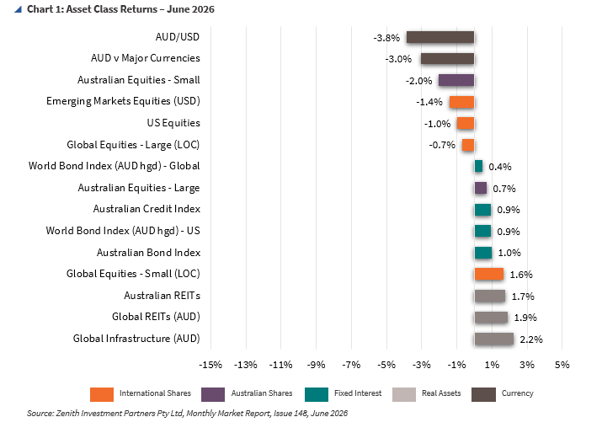
Property and infrastructure investments generated positive returns over the year, although they generally lagged broader global share markets. Global listed property trusts benefited from improving investor confidence and expectations that interest rates may stabilise. Australian property securities also recovered strongly during the June quarter, although full-year returns remained weaker due to earlier sector-specific challenges.
Infrastructure assets continued to benefit from several long-term themes. Growing electricity demand from AI technologies, investment in energy networks and concerns around energy security supported the sector. Despite some pressure from higher bond yields, infrastructure delivered solid returns and remains well positioned to benefit from ongoing investment in power generation and distribution.
Fixed Interest – Global
Global bond markets experienced a year of shifting expectations around inflation, economic growth and central bank policy. Investors initially anticipated lower interest rates as labour markets softened and inflation eased. However, rising energy prices and resilient economic growth created concerns that inflation might remain higher for longer. As a result, bond yields remained relatively elevated throughout much of the year.
In the United States, the Federal Reserve cut rates in late 2025 but became more cautious during 2026 as economic activity remained stronger than expected. Similar trends were seen in Europe and Japan, where central banks continued balancing inflation concerns against slowing growth.
Although bond returns were positive, investors remained focused on whether central banks would need to maintain higher interest rates for longer than previously expected. Corporate bond markets remained relatively resilient, supported by healthy company balance sheets and limited signs of financial stress.
Fixed Interest – Australia
Australian bond markets faced challenges from persistent inflation and a more aggressive approach from the RBA. Bond yields rose earlier in the year as the central bank increased interest rates to address ongoing price pressures and prevent inflation from becoming entrenched.
Conditions improved somewhat during May and June as inflation indicators moderated, and investors reduced expectations for further rate rises. Australian government bond yields moved lower from their peak levels, delivering more favourable returns for fixed interest investors.
However, economic conditions remain finely balanced. Consumer confidence is weak, housing markets have softened and employment growth has slowed. While there are signs inflation may be easing, underlying inflation remains above the RBA's target range, meaning interest rates could stay relatively high for some time. Investors are likely to continue monitoring inflation and central bank decisions closely over the coming months.
Commodities and Currencies
Commodities delivered strong overall performance during the financial year, supported by global growth, the energy transition, AI-related infrastructure spending and geopolitical tensions. Industrial metals such as copper benefited from growing demand linked to electrification, data centres and power-grid upgrades.
Energy markets were volatile, with oil prices rising sharply during Middle East tensions before retreating as fears of prolonged supply disruptions eased. Gold also experienced significant swings as changing interest-rate expectations influenced investor demand.
Currency markets reflected the relative strength of the US economy. The US dollar remained resilient as investors favoured its safe-haven characteristics and higher yields.
In contrast, the Australian dollar weakened later in the year as commodity prices eased, confidence softened and the gap between Australian and US interest-rate expectations narrowed. The Japanese yen also remained unusually weak despite higher local interest rates.
Key Takeaways for Investors
- Global shares continued to outperform, driven by strong earnings growth and ongoing investment in AI-related industries.
- Australian markets delivered positive returns but lagged overseas markets due to limited technology exposure and a more challenging domestic economic environment.
- Inflation remains the key issue for investors, influencing interest-rate decisions, bond yields and market sentiment globally.
- Diversified portfolios benefited from exposure to global equities, infrastructure, commodities and fixed interest as leadership rotated across different asset classes during the year.
Bottom Line for Investors
Markets ended the year in a stronger position than expected, but investors should avoid assuming the recent winners will continue to lead. While AI remains an important long-term theme, the opportunity set is broadening, and future returns are likely to depend on selectivity, diversification and valuation discipline.
In this environment, disciplined portfolio construction and staying invested across a range of asset classes remain more important than reacting to short-term market moves.
Looking for Personal Financial Advice?
This investment update is a general overview of market movements for the month. For personal financial advice to achieve your investment goals, contact your FMD adviser.
If you're new to FMD, but ready to get serious about planning your financial future or a worry-free retirement, book an initial discovery meeting with one of our financial advisers in Melbourne, Adelaide or Brisbane.
General advice disclaimer: This article has been prepared by FMD Financial and is intended to be a general overview of the subject matter. The information in this article is not intended to be comprehensive and should not be relied upon as such. In preparing this article we have not taken into account the individual objectives or circumstances of any person. Legal, financial and other professional advice should be sought prior to applying the information contained on this article to particular circumstances. FMD Financial, its officers and employees will not be liable for any loss or damage sustained by any person acting in reliance on the information contained on this article. FMD Group Pty Ltd ABN 99 103 115 591 trading as FMD Financial is a Corporate Authorised Representative of FMD Advisory Services Pty Ltd AFSL 232977. The FMD advisers are Authorised Representatives of FMD Advisory Services Pty Ltd AFSL 232977. Rev Invest Pty Ltd is a Corporate Authorised Representative of FMD Advisory Services Pty Ltd AFSL 232977.