



Economic Snapshot: Australia holds firm amidst market volatility
July was a volatile month for global markets, driven by renewed conflict in the Middle East, rising oil prices, and growing investor concerns about whether the significant spending on artificial intelligence (AI) infrastructure will generate sufficient returns. Together these factors created sharp swings across financial markets, particularly in technology-related sectors.
Global share markets generally struggled, although the weakness was largely concentrated in AI and semiconductor stocks rather than the broader market. Bond markets also came under pressure as higher energy prices raised concerns that inflation could remain stubbornly elevated, prompting central banks to maintain a cautious stance on interest rates.
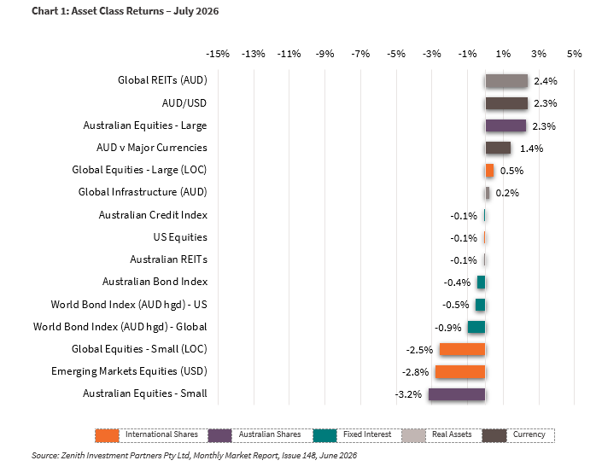
Australian shares held up much better than many overseas markets gaining around 2.3% for the month. Strong performances from financial and resource companies, combined with the market’s relatively low exposure to the technology stocks, supported returns. Inflation also eased slightly, reducing expectations of further interest rate increases.
Global Developed Equities
Global share markets experienced a challenging month in July as geopolitical tensions and concerns around AI-related investments weighed on investor sentiment. Renewed conflict between the United States and Iran pushed energy prices sharply higher and reignited concerns that inflation could remain above central bank targets for longer than expected.
Investors also questioned whether AI-related spending would justify elevated technology valuations. This led to a steep sell-off in semiconductor companies, with the sector recording its weakest monthly performance in more than a decade. Despite weakness in technology shares, broader corporate earnings remained resilient.
Importantly, the weakness was not widespread across all sectors. Energy and financial companies performed well, supported by higher oil prices and a favourable economic backdrop. As a result, the broader market remained relatively resilient, with the MSCI World ex Australia Index returning approximately 0.5% over the month and remaining more than 10% higher for the year to date in US dollar terms.
The US Federal Reserve also maintained a firm stance on inflation despite holding interest rates unchanged. This reinforced expectations that policy rates may remain elevated for longer, creating additional uncertainty for investors.
Australian Equities
Australian shares delivered a comparatively strong performance in July, with the ASX 200 rising approximately 2.3%. Unlike many Asian and global markets, Australia was largely insulated from the sharp technology sector sell-off because technology companies make up a much smaller proportion of the local market.
Investor sentiment was also supported by signs that inflation pressures may be easing. June quarter inflation data came in lower than expected, reducing concerns that the Reserve Bank of Australia (RBA) would need to continue raising interest rates aggressively.
Equity market sector performance reflected these broader trends. Energy companies benefited from stronger oil prices, financial stocks also produced solid gains, and healthcare continued its recovery. By contrast, the technology sector remained under pressure due to the global reassessment of AI-related investments.
Despite ongoing uncertainty, Australian equities demonstrated resilience during the month, supported by easing inflation and the market’s favourable sector composition.
Emerging Markets
Emerging market shares faced a difficult month as investors reassessed AI and semiconductor valuations. Countries such as South Korea and Taiwan were among the hardest hit; with South Korea particularly exposed given Samsung Electronics and SK Hynix represent close to half of the local share market index.
The result was significant volatility, with the Korean market recording one of its strongest daily gains on record during July while still finishing the month among its weakest since the Global Financial Crisis.
The sharp fall in semiconductor stocks led to significant declines in some Asian markets despite many companies continuing to report strong earnings growth. Strong earnings were often insufficient where markets had already priced in even stronger future growth expectations.
The MSCI Emerging Markets Index fell around 4.4% in Australian dollar terms during July, although it remains up roughly 14% for the year to date. China was a relative bright spot, supported by expectations of further government stimulus measures aimed at supporting economic activity. However, ongoing weakness in China's property sector and subdued consumer demand continue to weigh on growth prospects.
Property and Infrastructure
Listed property and infrastructure investments proved resilient despite higher bond yields during July. While rising yields can reduce the relative attractiveness of income-producing assets, improving property fundamentals and limited new supply supported returns. Global REITs gained around 2.4% during the month, while infrastructure assets delivered modest positive returns as investors continued to value their stable cash flows and inflation-linked characteristics.
In Australia, listed property and infrastructure assets were influenced by shifting expectations for interest rates. The RBA's decision to leave rates unchanged helped offset some of the pressure from higher global bond yields.
Fixed Interest – Global
Global bond markets weakened during July as investors reassessed the outlook for inflation and interest rates. Higher energy prices and a firm Federal Reserve reinforced expectations that policy rates may remain elevated for longer, pushing government bond yields higher. While government bonds faced headwinds, credit markets remained relatively resilient, supported by healthy corporate balance sheets and the attractive income available to investors.
Fixed Interest – Australia
June quarter inflation data continued to moderate, leading investors to scale back expectations for further RBA rate increases. While economic activity remains soft, unemployment has stayed relatively low, supporting the view that the current tightening cycle may be approaching its end.
although bond markets experienced some short-term volatility during the month, current yields continue to provide income opportunities than have not been available to investors for many years.
Commodities and Currencies
Commodity markets were dominated by developments in the Middle East. Oil prices surged approximately 24% during the month as renewed conflict raised concerns about global energy supply. By contrast, gold was largely unchanged, balancing safe-haven demand against higher interest rates and a stronger US dollar. Copper reached record highs, supported by long-term demand linked to electrification, infrastructure investment and AI-related technologies.
Currency markets were mixed. The Australian dollar strengthened modestly, finishing near US$0.70 and benefiting from higher commodity prices. The US dollar was weaker than many investors expected despite higher bond yields, while the Japanese yen remained volatile amid intervention efforts and shifting interest rate expectations.
Key Takeaways for Investors
- Market volatility increased during July, but much of the weakness was concentrated in technology and AI-related stocks rather than the broader market.
- Australian shares outperformed many global markets, supported by easing inflation, stronger performances from financial and resources companies, and the market’s relatively low exposure to technology stocks.
- July highlighted how concentrated some markets have become around the AI and semiconductor theme, contributing to larger market swings as investors reassessed growth expectations.
- Fixed interest investments experienced short-term volatility as interest rate expectations shifted, but higher bond yields continue to create more attractive long-term income opportunities for investors.
Bottom Line for Investors
July highlighted how quickly markets can react to changing economic and geopolitical conditions. While concerns about inflation, interest rates and AI-related valuations created volatility, the broader global economy remains relatively resilient and corporate earnings continue to grow.
Australian markets were among the more resilient during the month, supported by easing inflation and favourable market sector exposures. Areas of the market that had been leading performance came under pressure, while others proved more resilient, reinforcing how difficult it is to consistently predict short-term market direction.
For long-term investors, diversification and a focus on long-term goals remain important foundations for investment success.
Looking for Personal Financial Advice?
This investment update is a general overview of market movements for the month. For personal financial advice to achieve your investment goals, contact your FMD adviser.
If you're new to FMD, but ready to get serious about planning your financial future or a worry-free retirement, book an initial discovery meeting with one of our financial advisers in Melbourne, Adelaide or Brisbane.
General advice disclaimer: This article has been prepared by FMD Financial and is intended to be a general overview of the subject matter. The information in this article is not intended to be comprehensive and should not be relied upon as such. In preparing this article we have not taken into account the individual objectives or circumstances of any person. Legal, financial and other professional advice should be sought prior to applying the information contained on this article to particular circumstances. FMD Financial, its officers and employees will not be liable for any loss or damage sustained by any person acting in reliance on the information contained on this article. FMD Group Pty Ltd ABN 99 103 115 591 trading as FMD Financial is a Corporate Authorised Representative of FMD Advisory Services Pty Ltd AFSL 232977. The FMD advisers are Authorised Representatives of FMD Advisory Services Pty Ltd AFSL 232977. Rev Invest Pty Ltd is a Corporate Authorised Representative of FMD Advisory Services Pty Ltd AFSL 232977.