



Economic Snapshot: A Positive Month for Markets
August was a stronger month for global share markets after July’s technology-led sell-off. Investors moved back into large US technology and AI-related companies, helped by better-than-expected company earnings and softer US inflation. Global shares rose over the month, although the stronger Australian dollar reduced returns for unhedged Australian investors.
Australian shares also rose, but not as strongly as global markets. Small and mid-sized companies performed well, supported by gold miners, while listed property was weak as higher bond yields weighed on returns. The Reserve Bank of Australia left the cash rate unchanged at 4.35%, although inflation remains above target and markets are still alert to the possibility of further rate rises.
Bond markets were mixed. Global bonds produced a small positive return, while Australian bonds edged lower as local yields rose. Commodities were generally strong, led by gold and industrial metals, and the Australian dollar strengthened against the US dollar. Overall, August was a reminder that markets can recover quickly, but returns remain sensitive to inflation, interest rates, currency moves and geopolitical risks.
Global Developed Equities
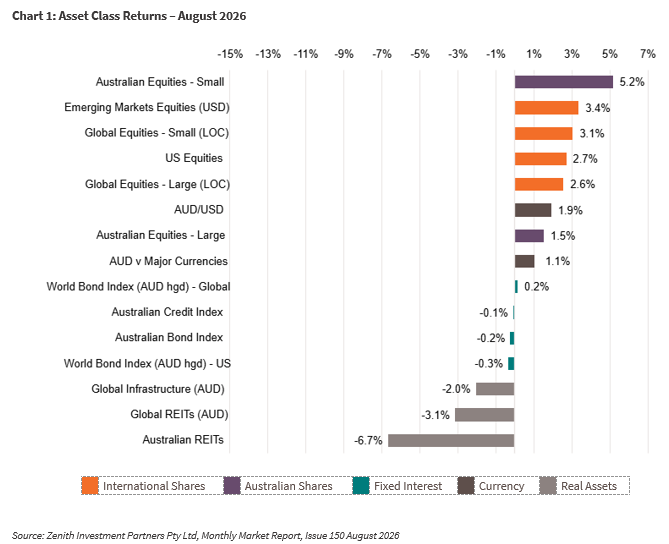
Global developed share markets recovered in August as investors returned to the technology and AI-related companies that had been sold down in July. The MSCI World ex Australia Index rose 2.6% in US dollar terms, bringing its year-to-date gain to 13.1%. For Australian investors with unhedged global shares, the stronger Australian dollar reduced the monthly return to 0.5%, while fully hedged global shares returned 2.5%.
The strongest support came from company earnings. US companies delivered very strong profit growth for the June quarter, with large technology names again playing an important role. Importantly, the recovery was not limited to the biggest technology companies, with broader US earnings also improving. European companies also reported their strongest growth since 2022, led by banks.
Softer US inflation helped investor confidence. Headline inflation eased to 3.4%, and core inflation edged lower, reducing some pressure on the US Federal Reserve. This supported markets, although oil price volatility and ongoing Middle East tensions kept inflation risks in focus.
Japan, Germany and China were among the stronger regional markets, while smaller companies also performed well. Even so, markets are now priced for a fairly positive outcome: solid economic growth, only limited further interest rate rises and no lasting shock from higher oil prices. That leaves less margin for disappointment. Valuations, particularly in the US, remain elevated and investors should expect some ongoing volatility if earnings, inflation or interest rates surprise.
Australian Equities
Australian shares rose in August but lagged the stronger rebound in global markets. The ASX 200 returned 1.5% for the month, taking its year-to-date return to 6.3%. The result reflected a mixed local market, with smaller companies doing much better than the largest stocks.
Small and mid-sized companies were the standout performers. The Small Ordinaries rose 5.2%, helped by a strong month for gold miners as the gold price climbed sharply. By contrast, the largest companies delivered more modest gains, and listed property was the weakest area of the market as higher bond yields weighed on investor sentiment.
Company reporting season produced some large individual share price moves. CSL recovered strongly, while BHP benefited from firmer commodity prices. The major banks were weaker, partly because investors are watching slower housing credit growth and the potential for higher bad debts.
The Reserve Bank kept the cash rate unchanged at 4.35% in August. Earlier in the year, expectations had been for rates to rise further, but softer housing activity and weaker business confidence have reduced those expectations. However, inflation remains above the RBA’s target range, so the path for interest rates is still uncertain. For investors, the Australian market remains highly sensitive to company earnings, inflation trends and bond yields.
Emerging Markets
Emerging markets were one of the strongest areas of global share markets in August. Returns were helped by renewed interest in North Asian technology companies, particularly those linked to semiconductors and AI infrastructure. The broader emerging markets index rose 3.4% in US dollar terms for the month.
China’s export data also supported the technology demand story, with strong shipments linked to the global AI build-out. However, outside technology and exports, China’s economy remains under pressure, particularly in property and infrastructure.
The main risk is concentration. Korea and Taiwan now make up a large share of the emerging markets index, which means returns are closely tied to the AI and semiconductor cycle. A weaker US dollar and improving global growth are supportive, but investors should expect this asset class to remain more volatile than developed markets.
Property and Infrastructure
Property and infrastructure were weaker in August as higher long-term bond yields reduced the appeal of income-focused assets. Australian listed property was hit hardest, falling 6.7% for the month, while global listed property also declined.
Infrastructure held up better but still finished lower. These sectors often appeal to investors because of their relatively steady cash flows, but they can be sensitive to changes in bond yields. When bond yields rise, investors often demand higher returns from property and infrastructure, which can put downward pressure on prices.
Fixed Interest – Global
Global bond markets were mixed in August. The main global bond index, hedged to Australian dollars, returned 0.2%. US long-term yields were broadly steady, while shorter-term yields rose as markets weighed inflation and interest rate risks.
Softer US inflation helped sentiment, but investors remain cautious while inflation sits above target and government debt remains high. The US Treasury’s move to buy more longer-dated bonds may support stability, but its lasting impact is unclear.
Credit markets were more resilient as risk appetite improved. Corporate bond spreads remain low, but income from many high-quality bonds is still far more attractive than during the ultra-low rate years.
Fixed Interest – Australia
Australian bonds had a weaker month as local yields rose. The Australian 10-year government bond yield finished August at 5.09%, while the broad Australian bond index returned -0.2% for the month. This reflected investor concern that inflation may remain stickier than hoped, even as parts of the economy, including housing and business confidence, continue to soften.
The Reserve Bank kept the cash rate at 4.35% in August, but the market’s expectations have shifted several times this year. By month end, investors were pricing in only limited further rate increases, although higher July inflation data later revived the possibility of more tightening. Within fixed interest, shorter-term and floating-rate credit held up better than longer-duration bonds, showing the value of staying diversified across different types of fixed income.
Commodities and Currencies
Commodities were strong in August. Oil remained volatile, while gold rose 10% to US$4,448 an ounce on US dollar weakness and demand for stores of value. Industrial metals also gained, supported by electrification, grid investment and AI-related data centre demand.
The Australian dollar rose to US$0.72 as the US dollar weakened, reflecting stronger commodities and better global risk appetite, but reducing returns from unhedged global assets.
Key Takeaways for Investors
- Markets recovered strongly in August, led by global shares and technology-related companies, but valuations remain high and leave less room for disappointment.
- Australian shares rose but lagged global markets, with small companies and gold miners performing well while listed property struggled.
- Interest rates and inflation remain important drivers of investment returns, particularly for bonds, property and other income-focused assets.
- A stronger Australian dollar helped signal better global risk appetite, but reduced returns from unhedged global investments for Australian investors.
Bottom Line for Investors
August showed markets can rebound quickly when inflation eases, company profits are strong and confidence improves. But risks remain, including high inflation, higher bond yields, oil price shocks and expensive share markets.
For investors, the key is to stay balanced and avoid chasing recent winners. Growth assets may keep doing well if profits hold up, but high prices mean markets could react quickly to bad news. Fixed interest now offers better income, but bond values can still move as rate expectations change.
Diversification remains important. A well-built portfolio can take part in market growth while helping manage the impact of inflation, rate changes and global risks
Looking for Personal Financial Advice?
This investment update is a general overview of market movements for the month. For personal financial advice to achieve your investment goals, contact your FMD adviser.
If you're new to FMD, but ready to get serious about planning your financial future or a worry-free retirement, book an initial discovery meeting with one of our financial advisers in Melbourne, Adelaide or Brisbane.
General advice disclaimer: This article has been prepared by FMD Financial and is intended to be a general overview of the subject matter. The information in this article is not intended to be comprehensive and should not be relied upon as such. In preparing this article we have not taken into account the individual objectives or circumstances of any person. Legal, financial and other professional advice should be sought prior to applying the information contained on this article to particular circumstances. FMD Financial, its officers and employees will not be liable for any loss or damage sustained by any person acting in reliance on the information contained on this article. FMD Group Pty Ltd ABN 99 103 115 591 trading as FMD Financial is a Corporate Authorised Representative of FMD Advisory Services Pty Ltd AFSL 232977. The FMD advisers are Authorised Representatives of FMD Advisory Services Pty Ltd AFSL 232977. Rev Invest Pty Ltd is a Corporate Authorised Representative of FMD Advisory Services Pty Ltd AFSL 232977.